Guide
How to register a clinic in India. Which law applies in your state, and what it asks for.
Clinic registration in India is a state matter. Nineteen states and union territories run the central Clinical Establishments Act, five large states have their own Acts, and the rest are in between. This guide tells you which situation you are in, what provisional and permanent registration mean, and what else a new clinic has to register for.
At a glance
- Central Act applies in
- 19 states and UTs
- Own state Acts
- Karnataka, Gujarat, Tamil Nadu, West Bengal, Kerala
- Provisional registration
- 6 months, renewable
- Permanent registration
- 5 years
- Single-doctor clinics
- Covered by the Act
- Maharashtra
- 2026 Bill in committee
Checked 2026-10-20.
Three situations. Find yours first.
Health is a state subject. The central Act applies only in a state that has adopted it under Article 252 of the Constitution, so the first question is which law your state uses.
- Situation 1
Your state adopted the central Act
The Clinical Establishments (Registration and Regulation) Act, 2010 and its 2012 rules apply. You register with the district registering authority, provisionally first, then permanently once the state notifies minimum standards. The table below lists the 19 states and UTs.
- Situation 2
Your state has its own Act
Karnataka, Gujarat, Tamil Nadu, West Bengal and Kerala never adopted the central Act and run their own laws with their own forms, fees and authorities. The second table names each Act.
- Situation 3
Neither, yet
Several states have older nursing-home laws that cover bedded establishments and say little about a clinic with no beds. Maharashtra tabled a Bill in July 2026 to replace its 1949 Act; it was before a Joint Committee in August 2026. In Delhi, the DGHS Nursing Home Cell registers establishments with indoor admission of at least two beds.
States and union territories under the central Act
From the Ministry of Health's Clinical Establishments portal, page last updated 19 October 2026. A 2026 Lok Sabha answer puts the count at 12 states and seven union territories; the portal list is what the registering authorities work from.
| State or UT | Type |
|---|---|
| Assam | State |
| Arunachal Pradesh | State |
| Bihar | State |
| Haryana | State |
| Himachal Pradesh | State |
| Jharkhand | State |
| Mizoram | State |
| Rajasthan | State |
| Sikkim | State |
| Uttar Pradesh | State |
| Uttarakhand | State |
| Andaman and Nicobar Islands | Union territory |
| Chandigarh | Union territory |
| Dadra and Nagar Haveli | Union territory |
| Daman and Diu | Union territory |
| Jammu and Kashmir | Union territory |
| Ladakh | Union territory |
| Lakshadweep | Union territory |
| Puducherry | Union territory |
States with their own clinical establishment laws
These states did not adopt the 2010 Act. Their own Acts set the forms, fees and authorities.
| State | Law | Note |
|---|---|---|
| Karnataka | Karnataka Private Medical Establishments Act, 2007 | Registration with the district registration and grievance redressal authority. |
| Gujarat | Gujarat Clinical Establishments (Registration and Regulation) Act, 2021 | Rules amended in 2024; the same document set goes with the provisional and the permanent application. |
| Tamil Nadu | Tamil Nadu Private Clinical Establishments (Regulation) Act, 1997 | Older Act; check the current rules with the district health office. |
| West Bengal | West Bengal Clinical Establishments (Registration, Regulation and Transparency) Act, 2017 | Also set up the West Bengal Clinical Establishment Regulatory Commission. |
| Kerala | Kerala Clinical Establishments (Registration and Regulation) Act, 2018 | Under challenge before the Supreme Court; private hospitals were granted interim relief. Registration continues under the Act meanwhile. |
| Maharashtra | Bombay Nursing Homes Registration Act, 1949, until the 2026 Bill passes | The Maharashtra Clinical Establishments (Registration and Regulation) Bill, 2026 was introduced on 3 July 2026 and sent to a Joint Committee. |
Does a single-doctor clinic have to register?
Under the central Act, yes. Section 2(c) defines a clinical establishment to include a clinic, dispensary or consulting room by whatever name called, and extends the definition to one owned, controlled or managed by a single doctor. The only establishments outside the Act are those of the Armed Forces.
The state Acts are written the same way: they apply by the nature of the service, not by size. Where an older nursing-home law is the only law in force, it usually turns on indoor admission, which is why a bedless clinic in Delhi should ask the DGHS Nursing Home Cell before assuming it is exempt.
How registration works under the central Act
The sequence set by the 2010 Act and summarised in the PRS brief on the 2026 Maharashtra Bill, which compares the two.
- Provisional registration firstApply to the district registering authority. No inquiry is made before provisional registration is granted. It is valid for six months and renewable.
- Existing clinics get a windowA clinic that already exists when the Act commences in the state must apply within six months of commencement, or six months before its current registration expires, whichever is earlier.
- Minimum standards change the clockOnce the state notifies minimum standards, provisional registration cannot be renewed beyond two years for clinics that existed before the notification, or six months for clinics set up afterwards.
- Permanent registrationApply at least 60 days before the provisional registration expires, with evidence that the clinic meets the standards. The authority displays the application publicly and invites objections. Permanent registration is valid for five years.
- Fees are set locallyThe registering authority levies fees for registration and renewal. The Act fixes no amount; the state rules and the district office do. Ask for the fee schedule before filing.
- Display the certificateThe certificate of registration has to be displayed at a conspicuous place in the clinic. Changes of ownership, management or category are reported to the authority.
What the application usually asks for
The exact list is in your state's rules. The items below are what the state portals and the Gujarat 2024 amendment ask for in practice, so you can gather them before you open the form.
- Identity and PAN of the owner or the partners, and the constitution of the entity if the clinic is a company, LLP or trust
- Proof of the premises: ownership deed or lease, and a recent utility bill
- The doctor's degree certificates and the State Medical Council or National Medical Register registration certificate
- A list of staff with qualifications and registration numbers where the role needs one
- A list of equipment and the services the clinic will offer, by system of medicine
- Layout or floor plan with the area in square feet
- Bio-medical waste authorisation from the State Pollution Control Board, or proof that it has been applied for
Other registrations a new clinic needs
Clinical establishment registration is one of several. These are the ones that apply almost everywhere.
Bio-medical waste authorisation
Rule 10 of the Bio-Medical Waste Management Rules, 2016 requires every occupier that generates bio-medical waste to obtain authorisation from the State Pollution Control Board or Pollution Control Committee, whatever the quantity. Non-bedded clinics are granted a one-time authorisation; it has to be applied for afresh if the clinic adds beds. You also sign up with a common bio-medical waste treatment facility.
Shops and establishments
Most states require a clinic to register under their Shops and Establishments Act within a set period of opening, through the labour department's portal. Requirements and exemptions differ by state and by number of employees.
Premises-dependent approvals
A fire no-objection certificate, a municipal trade licence or a signboard licence depend on the building, the floor area and the municipality. Ask the local body; a ground-floor consulting room and a day-care centre are treated differently.
Registered. Now the first patient.
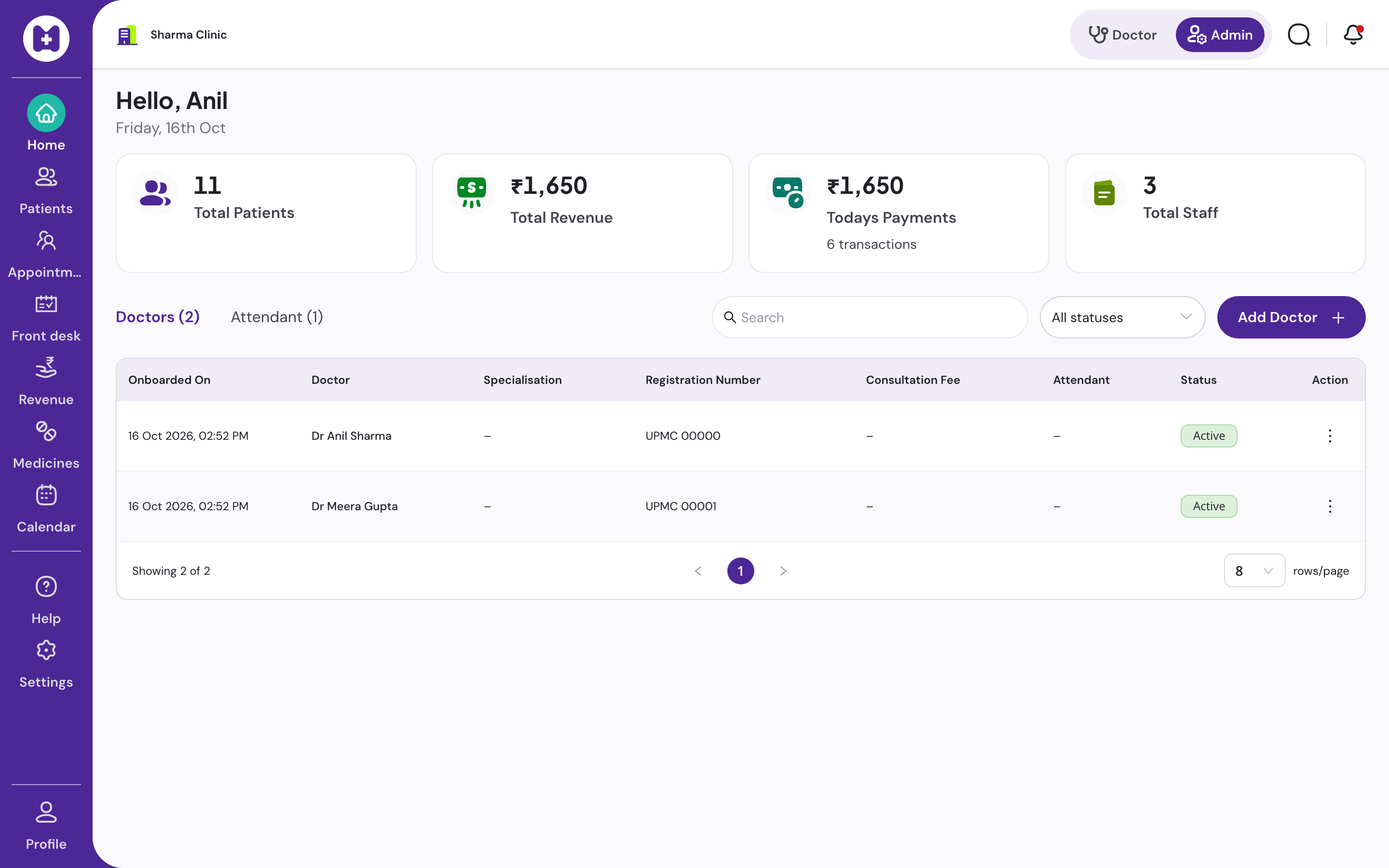
Vitels sets up a clinic in about ten minutes: registration, token queue, prescription pad on your letterhead, billing and reports. Works offline. No licence fee.
Questions
Straight answers
01Is clinic registration compulsory in India?
In the 19 states and UTs that adopted the 2010 Act, and in the five states with their own Acts, yes. Elsewhere the older nursing-home laws apply to bedded establishments; a clinic without beds should confirm its position with the state health department rather than assume it is exempt.
02Does a single-doctor clinic need to register under the Clinical Establishments Act?
Yes. Section 2(c) of the Act includes a clinical establishment owned, controlled or managed by a single doctor, and lists clinics, dispensaries and consulting rooms by whatever name called.
03How long does provisional registration last?
Six months, renewable, until the state notifies minimum standards. After that it cannot be renewed beyond two years for a clinic that existed before the notification, or six months for a newer one, and the clinic applies for permanent registration.
04What does registration cost?
The Act leaves the fee to the registering authority, so it varies by state, by district and by the category of establishment. There is no national figure. Ask the district health office for the schedule before filing.
05What happens if a clinic runs without registration?
Section 41 of the central Act provides monetary penalties for carrying on a clinical establishment without registration, rising for repeat contraventions. The state Acts carry their own penalties.
06Is registration the same as NABH accreditation?
No. Registration is a legal requirement under the Act. NABH accreditation is voluntary and run by the Quality Council of India; the Act's minimum standards are separate from NABH's.
07Where are the minimum standards for a clinic?
The National Council for Clinical Establishments publishes minimum standards by category on the Ministry of Health's Clinical Establishments portal. States notify them for their territory, which is when the provisional-to-permanent clock starts.
This guide summarises public law and government documents as of 20 October 2026 and is general information, not legal advice. State rules change and district offices apply them; confirm the current requirement with your registering authority before you open.
Sources
Where this page comes from
Primary documents first. If a source and this page disagree, the source wins; write to us and we will fix the page.
- Ministry of Health, Clinical Establishments portal: states and union territories where the Act applies
- The Clinical Establishments (Registration and Regulation) Act, 2010, India Code
- Minutes of the 14th National Council for Clinical Establishments (MoHFW, 2025)
- PRS Legislative Research, brief on the Maharashtra Clinical Establishments (Registration and Regulation) Bill, 2026
- Vidhi Centre for Legal Policy, comments on the draft Maharashtra Bill, 2026
- Free Press Journal, Maharashtra introduces Bill to replace the 1949 Act (July 2026)
- Gujarat Clinical Establishments (Registration and Regulation) Amendment Rules, 2024
- Medical Dialogues, Supreme Court notice on the Kerala Clinical Establishments Act challenge
- Delhi DGHS Nursing Home Cell, FAQ
- Delhi Nursing Homes Registration Act, 1953, India Code
- Tamil Nadu Pollution Control Board, press release on one-time authorisation for non-bedded occupiers
- Odisha State Pollution Control Board, Bio-Medical Cell
- Punjab Pollution Control Board, office order on bio-medical waste authorisation (2018)
Keep reading
Related pages
- State medical councils in IndiaEvery council with its website, how registration and the National Medical Register work.Open
- Prescription pad makerYour letterhead with the registration number the regulations require.Open
- For clinic ownersDoctors, staff, fees, timings and reports for a small clinic.Open
Set up your clinic in about ten minutes.
Sign in with your mobile number, enter the clinic details, and our team verifies your medical council registration before patient registration switches on. Usually one working day.
No card · No licence fee · Export any time